
State of extreme exception tacitly recognized in the constitution and its application to the private sector
DOI:
https://doi.org/10.25057/2500672X.1309Keywords:
exception regime, Site status, State of emergency, State of calamity, State of shock, State of catastropheAbstract
The present work postulates the existence of a state of extreme exception, which would be implicitly recognized in the constitutions of several countries. At the same time, it points out how this exceptional regime affects both the public and private sectors.
In the work the historical method is used and an analysis of comparative law is made. The tin notion of "state of exception" is used, which includes the states of: "emergency", "alarm", "catastrophe", "siege", "war" or "calamity". After an introduction, it is explained how the state of exception has evolved over the centuries, and how the powers conferred on the president have been progressively limited, until in some countries they have constituted a weak state of exception. Then the deficiencies of that weak state of exception are observed to face crises such as the pandemic of the coronavirus covid-19. After confirming the above, applying the principles of necessity, self-preservation, proportionality and reasonableness, the existence of a “state of extreme exception” is proposed that allows the authorities to better deal with crises. How this new regime could work and what its limitations would be is indicated. Once the notion of this new exception regime has been established, and its scope delimited, it is analyzed how much impact it could have on the private sector.
Finally, the repercussions on the establishment of legal responsibility are analyzed, both in the public sector and in the private sector.
Downloads
Languages:
esReferences
AA.VV. (1950). Convenio Europeo de Derechos Humanos. Roma: Tribunal Europeo de Dere-chos Humanos. Recuperado de https://www.echr.coe.int/Documents/Convention_SPA.pdf.
Alemania. Ley Fundamental de la República Federal de Alemania de 1949 (Última modificación de 28 de marzo de 2019).
Alemania. Presidente. (28 de febrero de 1933). Verordnung des Reichspräsidenten zum Schutz von Volk und Staat. Recuperado de https://www.1000dokumente.de/index.html?c=doku-ment_de&dokument=0101_rbv&l=de.
Arango, A. (2020). ¿Son los estados de excepción el problema? El ejercicio de la función legis-lativa a partir de la delegación expresa del Congreso: el caso colombiano. Revista Derecho Del Estado, (46), 189-222. https://doi.org/10.18601/01229893.n46.08
Aristóteles (1985). Ética nicomaquea. Trad. de J. Pallí Bonet. Madrid: Gredos.
Asamblea General de Naciones Unidas. (1966) Pacto Internacional de Derechos Civiles y Políticos. Resolución 2200A. Naciones Unidas. Recuperado de https://www.ohchr.org/SP/ProfessionalInterest/Pages/CCPR.aspx
Chile. Plebiscito (1980). Constitución Política de la República de Chile. Santiago: Diario Oficial.Colombia.
Asamblea Nacional Constituyente. (1991). Constitución Política de Colombia. Bogotá:
Asamblea Nacional Constituyente.Corte Interamericana de Derechos Humanos (9 de abril de 2020). Declaración 1/20. Recupe-rado de http://www.corteidh.or.cr/tablas/alerta/comunicado/declaracion_1_20_ESP.pdf.
D’Ors, Á. (1961). Cicerón, sobre el estado de excepción. Cuadernos de la Fundación Pastor, 3, 11-31Dromi, R. (1994). Licitación pública (4ª ed.). Buenos Aires: Abeledo-Perrot.
Ecuador. Asamblea Nacional Constituyente. (1998). Constitución Política de la República de Ecuador. Quito: Asamblea Nacional Constituyente y Registro Oficial. Recuperado de https://pdba.georgetown.edu/Parties/Ecuador/Leyes/constitucion.pdf.
Ecuador. Ministerio de Trabajo (2020). Acuerdos MDT-2020-076, MDT-2020-077, MDT- 2020-080 y MDT-2020-081. Quito: Registro Oficial.
Ecuador. Presidencia de la República (20 de marzo de 2020). Decreto Ejecutivo No. 1017. Quito: Registro Oficial.
España. Referendum. (1978). Constitución. Madrid: Boletín Oficial del Estado, núm. 311, de 29 de diciembre de 1978.
Estados Unidos. Asamblea Constituyente. (1797). Constitución de los Estados Unidos de América. Filadelfia. Recuperado de https://www.constitutionfacts.com/content/constitution/files/USConstitution_Spanish.pdf.
Estados Unidos. Congreso (1977). International Emergency Economic Powers Act. Washington: 50 u.s.c. 1701.Estados Unidos. Congress (1976) National Emergencies Act. Washington: 50 u.s.c. 1601 et seq.
Estados Unidos. White House (16 de marzo de 2012). National Defense Resources Prepared-ness. Recuperado de https://obamawhitehouse.archives.gov/the-press-office/2012/03/16/executive-order-national-defense-resources-preparedness.
Faggiani, V. (2012). Los estados de excepción. Perspectivas desde el derecho constitucional europeo. Revista de derecho constitucional europeo, 17, 181-232.
Francia. Asamblea Nacional. (1958). Constitución Francesa. Paris: Asamblea Nacional.Hornblower, S., Spawforth, A. y Eidinow, E. (Eds.) (2012). The Oxford classical dictionary. Oxford: Oxford University Press.
Italia. Asamblea Constituyente. (1947). Constitución de la República Italiana. Roma: Asamblea Constituyente: Recuperado de http://www.ub.edu/ciudadania/hipertexto/evolucion/textos/ci1947.html
Massini, C. (2006). La ley natural y su interpretación contemporánea. Navarra: Eunsa.Messner, J. (1967). Derecho natural. Madrid: Rialp.Miranda, A. (5 de abril de 2020). Algunas de las peores epidemias. La Prensa. Recuperado de https://www.laprensa.com.ni/2020/04/05/opinion/2659927-algunas-de-las-peores-epidemias
Organización de Estados Americanos. (1969). Convención Americana de Derechos Humanos. San José de Costa Rica. Recuperado de https://www.oas.org/dil/esp/tratados_b-32_conven-cion_americana_sobre_derechos_humanos.htm
Perú. Congreso Constituyente Democrático. (1993). Constitución Política del Perú. Lima: Congreso Constituyente Democrático. Recuperado de https://www.oas.org/juridico/spanish/per_res17.pdf
Rhonheimer, M. (2000). La perspectiva de la moral. Madrid: Rialp.Sagües, N. (2003). Los roles del Poder Judicial ante el estado de necesidad. En Victor Bazan (Ed.), Defensa de la Constitución. Garantismo y controles (pp. 1045-1053). Buenos Aires: EDIAR.
Sagües, N. (2004). Teoría de la Constitución. Buenos Aires: Astrea.
Thurston, H. (2007). Harper’s Dictionary of Classical Antiquities. New York: Harper.
Tomas de Aquino. (1265-1272). Suma Teológica. París-Italia. Trad. de la BAC (2001). Suma Teológica de Santo Tomás de Aquino, 4ª ed. Madrid: BAC.
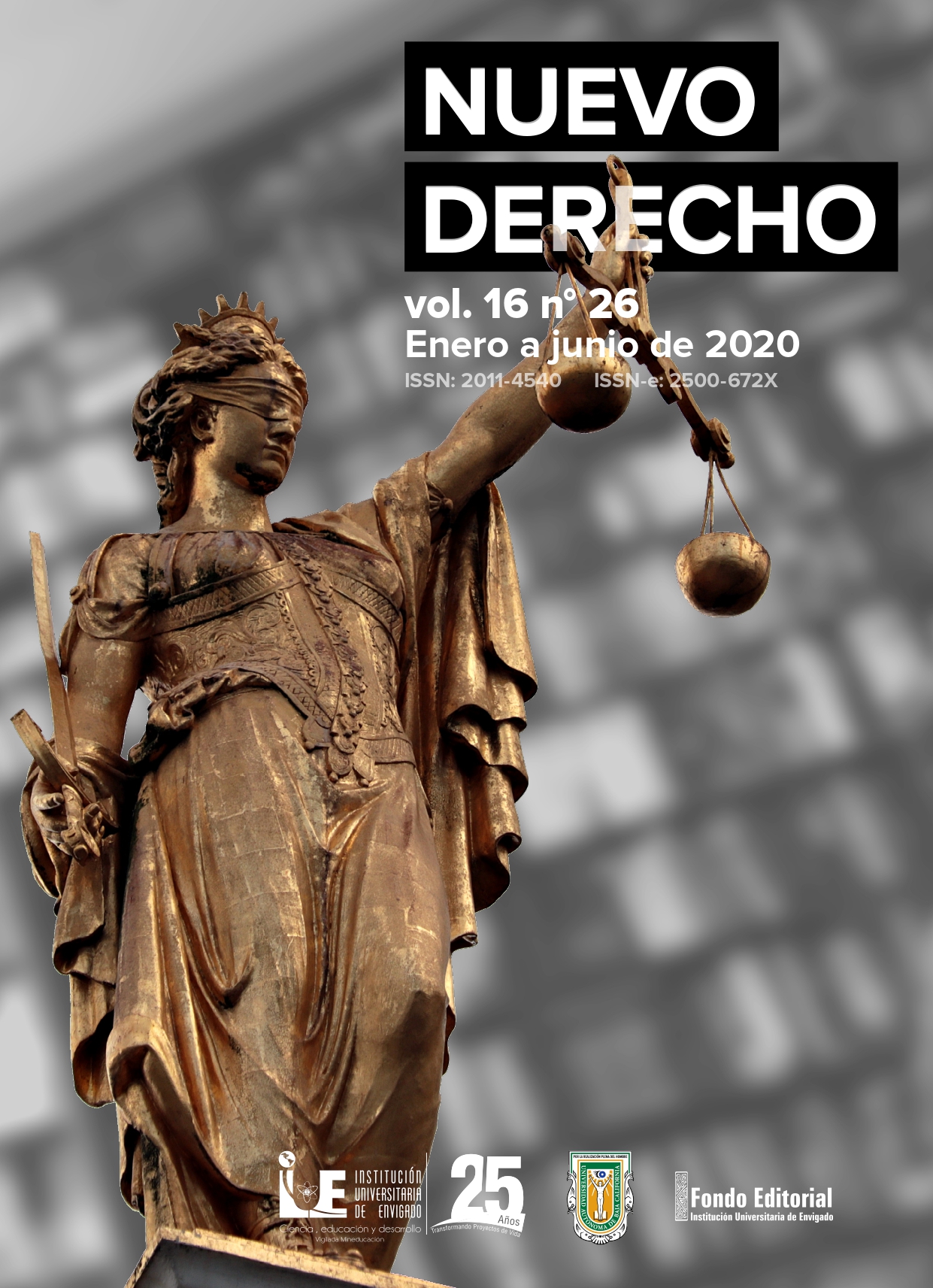
Downloads
Published
Versions
- 2020-07-27 (2)
- 2020-07-27 (1)
How to Cite
Issue
Section
License
Authors should declare that the article is an original work that has not been totally or partially published in any print or electronic media, which has not been submitted simultaneously to another publication and that is not currently under evaluation in another publication. On the other hand, I leave (we) evidence that the statements made therein are the sole responsibility of the / the authors / is.
All data and references to already published material are properly identified with their respective credit and included in the bibliographical notes and appointments that stand out as such and, in cases that require it, I have the proper authorizations for those with the respective rights; in case of any dispute or claim relating to intellectual property rights, we take responsibility exonerating responsibility to Nuevo Derecho.
If the article is approved for publication, the authors transfer the copyright to the journal New law to publish, distribute electronic copies and included in indexing services, directories or databases of national and international data on Open Access under the Creative Commons 3.0 Attribution-Noncommercial (CC bY-NC-SA) by which the authors retain their copyrights and allow them to others copy and distribute your work provided they recognize the corresponding authorship and the work is not used for purposes commercial.
Therefore, new law does not retain the rights to reproduce or copy (copyright), so the authors will have the final versions, to disseminate them in institutional repositories, personal blogs or any other electronic or print media, with the sole condition to make mention of the original source of publication, in this case Nuevo Derecho.
| Article metrics | |
|---|---|
| Abstract views | |
| Galley vies | |
| PDF Views | |
| HTML views | |
| Other views | |